
Getting to a deal decision is slow. Not because the analysis is difficult, but because of what comes before it.
A teaser arrives from an advisory firm. The analyst pulls company data, maps the competitive landscape, extracts financials from a workbook, cross-references notes from a call, and assembles everything into a PowerPoint that follows a specific structure. The structure matters because the senior team knows how to read it. The tables, the section flow, the financial metrics chosen for emphasis: these are not arbitrary. They reflect how that particular team evaluates deals.
The assembly itself is where the time goes. One mid-market M&A team recently described the process: four to five hours to build a single company overview, repeated four to five times a week. In more complex situations, where multiple sources of incoming information need to be studied and triaged for relevance before the assembly can start, the process stretches to days. Over 20 hours per week spent coordinating documents before anyone gets to the question that actually matters: is this deal worth pursuing?
That is not unusual. It is the industry norm.
The Scale Problem
This would be manageable if teams were evaluating one deal at a time. They are not.
Most Corp Dev and M&A teams are screening dozens of inbound opportunities in any given period. Every teaser that arrives starts the same manual process. Every company overview follows the same sequence of research, data gathering, workbook population, and slide assembly. The work is largely repetitive across deals, but it cannot be shortcut because the output quality has to hold.
The result is a bandwidth constraint that affects decision quality. Teams that can compress the assembly cycle evaluate more opportunities with the same headcount. Teams that cannot are making pass or pursue decisions on the basis of incomplete screens, because there is simply not enough time to run a thorough process on every inbound opportunity. Deals get a cursory glance and a pass, not because they lacked merit, but because the bandwidth to evaluate them properly did not exist.
The analyst's role in this dynamic is particularly constrained. Their job is to assemble a complete picture so that the senior partner can review a finished document and apply judgment, rather than doing the legwork. But when assembly takes hours per deal, the analyst becomes a bottleneck and the senior waits.
The Analyst's value is judgment, not prompt engineering
The industry's instinct has been to apply AI to this problem by building coded workflows. An analyst identifies a repeatable task, creates a prompt chain or skill, and hardwires it to a single LLM. The intention is sound. The execution introduces new problems.
First, it turns deal professionals into engineers. The analyst's value lies in judgment, sector knowledge, and the quality of their recommendations. Asking them to build and maintain coded AI workflows is a misallocation of the skill set that makes them useful.
Second, coded workflows are brittle. Deal structures vary. An 80% reinvestment deal requires a different document structure than a 100% asset acquisition. Most teams maintain multiple PowerPoint formats precisely because different deal types demand different presentations of the same underlying analysis. A coded workflow either has to be rebuilt for each variation or it forces every deal into the same shape. Neither outcome is acceptable.
Third, the result is locked to a single model. When a better model emerges for financial data extraction, or for narrative synthesis, or for research, the workflow cannot adapt without being rebuilt. In a market where model capabilities are shifting quarterly, that lock-in carries real cost.
The Workflow already exists
Most deal teams have already documented their process. They just do not think of it that way.
Every team has a set of documents that define how they work. A pre-offer summary in PowerPoint. An IC memo template. A financial overview workbook. These documents are not formatting conventions. They are the team's decision-making logic encoded in structure.
The headers, the table layouts, the section order, the financial metrics chosen for emphasis: all of this reflects institutional learning about what matters in a deal evaluation. It has been refined over years, shaped by feedback from investment committees, and embedded so deeply in working practice that most teams no longer think of it as a methodology. They think of it as "how the PowerPoint looks."
That distinction is important. Because when a team's evaluation process lives primarily in document templates and informal conventions, it is simultaneously valuable and fragile. Valuable because it represents real intellectual capital. Fragile because it depends on the people who know how to execute it.
Your PowerPoint is already a workflow. You just can't run it yet.
The shift that matters is converting existing document structures into workflows that AI agents can execute repeatedly.
A team uploads their PowerPoint template to Semaverse, the one they use for pre-offer summaries, company overviews, or IC presentations. Semaverse reads the structure: it identifies that this section requires a target overview, this table needs financial data in a specific format, this text box expects a competitive positioning summary. It extracts that structural logic and maps it to an agent workflow.
The team then adds their deal context. A teaser document from an advisory firm, an Excel workbook with financials, notes from a call, a company overview. The workflow runs against that context and produces a completed version of the team's own template, in their format, with their branding, populated with real data and analysis.
The output matches the team's template exactly. Same tables, same layout, same section flow, same branding. The AI populates the structure, it does not redesign it. The format is not arbitrary: it reflects how the team thinks about deals. When it matches exactly, the senior partner can go straight to judgment because the document reads the same way every time.
Because no two deals are the same, the approach is designed around variation. An acquisition of a family-owned business and a carve-out from a corporate parent require different analysis, different emphasis, different document structures. Teams maintain multiple templates for different deal types and select the relevant one for each evaluation. The variation is handled at the template level, not through re-engineering the AI.
The mid-market M&A team referenced earlier put this into practice. They uploaded their existing PowerPoint template, added an Excel workbook containing full financials and a company overview document as deal context, and the workflow produced a completed PowerPoint in their format. The process that previously took four to five hours now takes under 20 minutes. They run it for every new target.
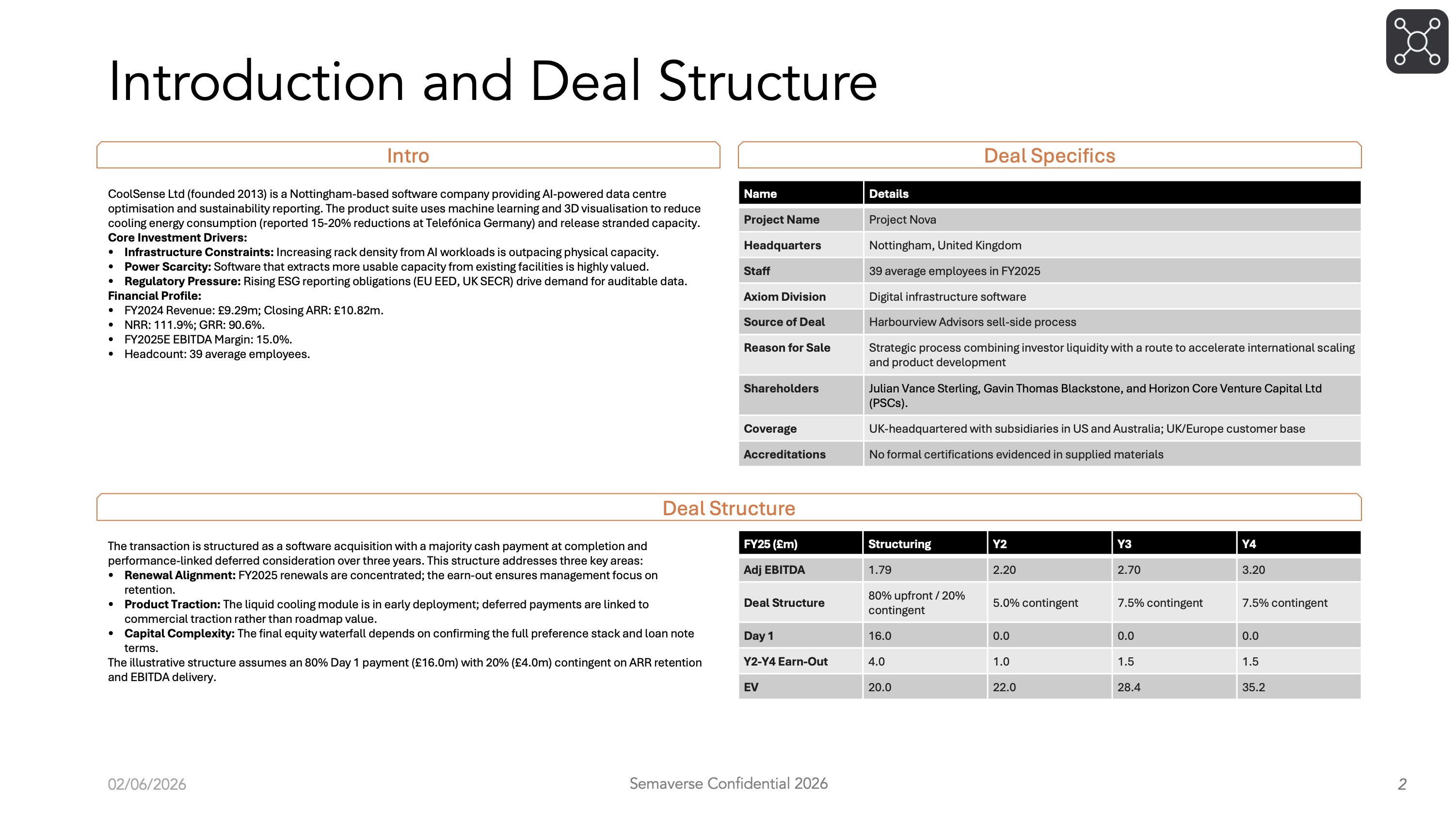
Example layout for the Pre-offer PowerPoint template
The time recovered is not an abstract efficiency gain. It is a reallocation of expertise. When the workflow handles the assembly, the analyst can run deeper financials on more deals and engage earlier in the evaluative work that the senior partner actually needs. The PowerPoint was never where the analyst added value. It was where their value got trapped.
Why general-purpose AI tools do not solve this
The most common objection to purpose-built deal workflows is that general-purpose AI can achieve the same result. Paste the teaser into a chat interface, ask for a summary, and the output appears instantly.
For a single, unstructured summary, this is true. For a repeatable process that matches a team's specific document structure, pulls from multiple data sources, maintains consistency across dozens of evaluations, and produces output that a junior analyst can generate and a senior partner can trust: it is not.
Every interaction with a general-purpose chat tool starts from zero. The prompt must be rewritten. The output must be reformatted. The structure must be manually enforced. There is no consistency across deals, no institutional template logic, and no transferability. The knowledge of how to use the tool effectively remains with the individual who wrote the prompt.
A workflow-based approach inverts this. The process is defined once, encoded in the template, and executable by anyone on the team. The institutional logic persists regardless of who runs it.
The compounding effect
The single-deal case for workflow-based AI is straightforward: faster assembly, consistent output, time redirected toward judgment. That case alone is compelling.
But the deeper advantage emerges at volume. When every evaluation runs through the same templated structure, teams build a library of consistently formatted assessments. They can compare across deals. They can identify patterns in what they pursue versus what they pass on. They develop sector knowledge that compounds with every evaluation, because each new assessment adds to a structured, searchable body of work rather than disappearing into an analyst's personal files.
Over time, this produces something that slower-moving teams cannot easily replicate: institutional memory that is documented, consistent, and independent of any single person's tenure. The team that has evaluated 200 targets through a structured workflow has a fundamentally different view of its market than the team that has evaluated 50 through ad hoc processes. That difference is a sourcing advantage, a conviction advantage, and increasingly, a competitive one.
The floor is rising
None of this diminishes the importance of human judgment in deal evaluation. The decision to pursue or pass on a target remains a synthesis of quantitative analysis, qualitative assessment, and strategic fit that no workflow can automate. That is the work. It should remain the work.
What is changing is the baseline expectation for how quickly a team can reach the point where that judgment is applied. The research standard that once required days of assembly can now be achieved in a fraction of that time. As more teams adopt workflow-based approaches, compressed timelines will cease to be an advantage and become the expected norm.
The moat is not the model. It is the workflow built around it. The teams that encode their process first will find themselves with compounding advantages in speed, consistency, and institutional knowledge that become progressively harder to replicate.
The question for any deal team is whether their evaluation process is still locked inside documents and conventions, or whether it has been converted into something that scales.
Semaverse converts existing deal templates into repeatable AI workflows. Upload your PowerPoint. Run the workflow. Get a completed document in your format, every time. Book a demo at semaverse.ai
Related blogs
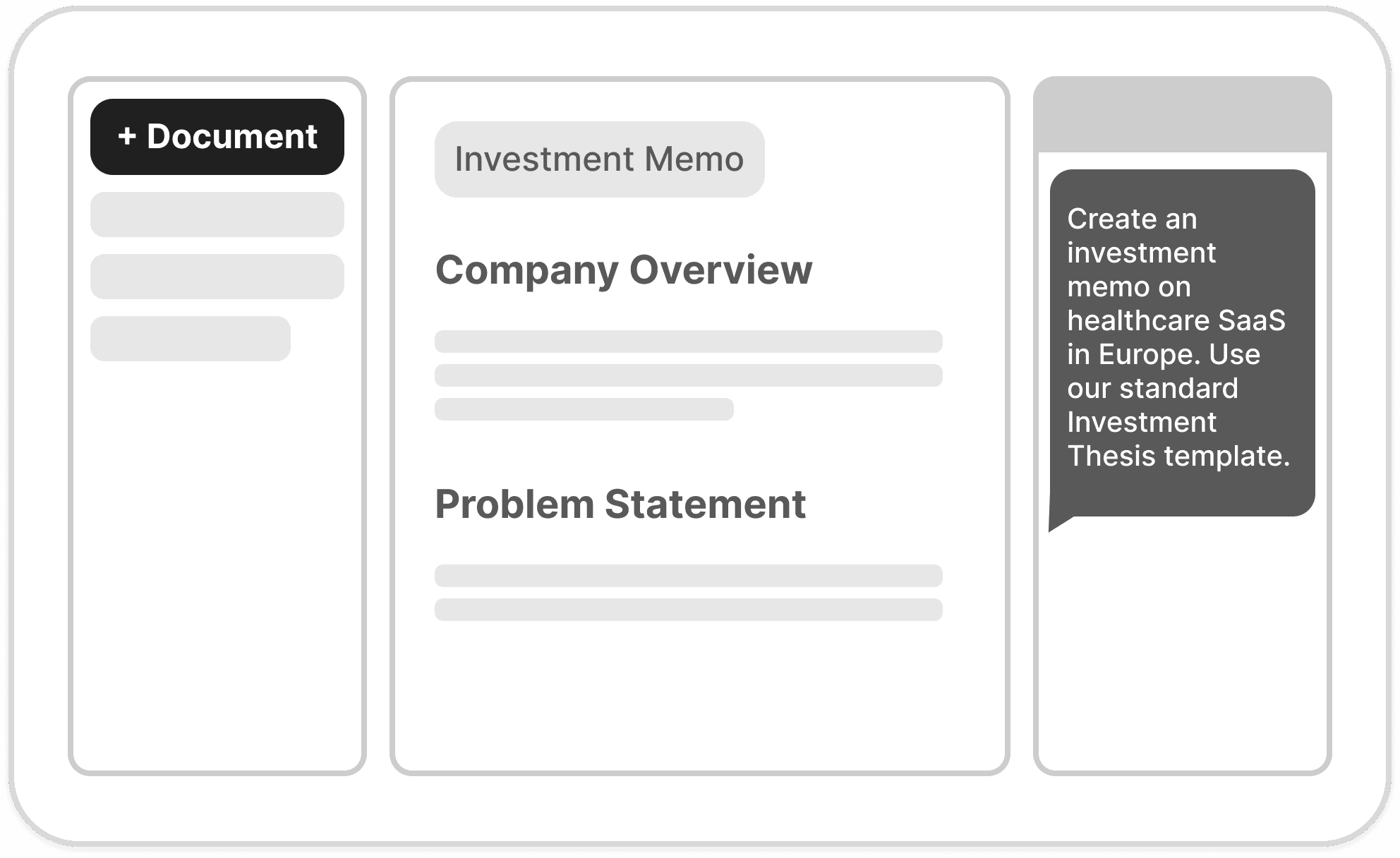
Semaverse Launches AI Intelligence Platform for Mergers and Acquisitions
Support for various content types such as articles, blogs, videos, and more. Rich text editor with formatting options for enhanced.
3rd Nov, 2025
Semaverse and PitchBook Partner to Deliver Context-Aware M&A Intelligence
Support for various content types such as articles, blogs, videos, and more. Rich text editor with formatting options for enhanced.
18th Feb, 2026

Semaverse Named in Top 100 UK Startups: Why the UK is the New Epicenter for AI-Driven M&A
Support for various content types such as articles, blogs, videos, and more. Rich text editor with formatting options for enhanced.
3rd March, 2026